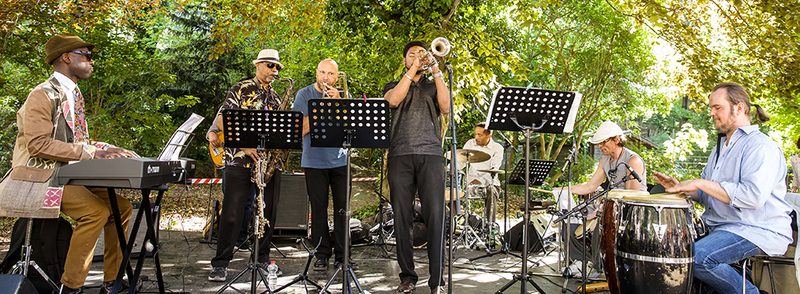
In dieser Edition unserer HOMAGE SESSION wird Das World-Jazz-Ensemble der WERKSTATT DER KULTUREN, die "Little Big Band", das Album "Latin American Suite“ von Duke Ellington spielen.
Besetzung
Bass - Matt Adomeit
Drums - Eric Vaughn
Piano - Reggie Moore
Sax, Flute - Fuasi Abdul-Khaliq
Trombone - Rob Gutowski
Trumpet - Christian Grabandt
Arranger Lionel Haas
"Latin American Suite“ von Duke Ellington
Latin American Suite is a studio album by American pianist, composer and bandleader Duke Ellington mainly recorded in 1968, with one track completed in 1970, and released on the Fantasy label in 1972.
Duke Ellington always absorbed influences from the music he heard as he toured the world, and The Latin American Suite is no exception. Written during his first tour of Central and South America in 1968, Ellington premiered several of the pieces during concerts in the Southern hemisphere, though he didn't record it until returning to the U.S., with one piece ("Tina") being recorded separately over a year after the other tracks. "Oclupaca" is an exotic opener showcasing Paul Gonsalves' robust tenor, while Ellington gets in an Oriental kick during his driving blues "Chico Cuadradino" (jointly written with his son Mercer). Ellington is in a jaunty mood in his bossa nova "Eque," which spotlights both Johnny Hodges and Gonsalves. The infectious "Latin American Sunshine" is buoyed by Harry Carney's sonorous baritone sax and trombonist Lawrence Brown's solo. It's a shame that Ellington chose not to keep any of these originals in his repertoire once work was completed on this album. Only 37 minutes long this collection of seven unrelated pieces (it's not really a suite) celebrated Ellington's first South American tour. Some of it suggests Latin dance music steeped in Ellingtonality, without much variation in the rhythms. Still, the supremely, unmistakably Ducal orchestral textures, the gently pervasive factor of His Grace's piano and the occasional touches of Paul Gonsalves, Johnny Hodges et al combine to make up for a thematic level that sometimes falls below optimum standards. No other ensemble ever produced voicings as memorably personal as Ellington's, even this late in his creative life.