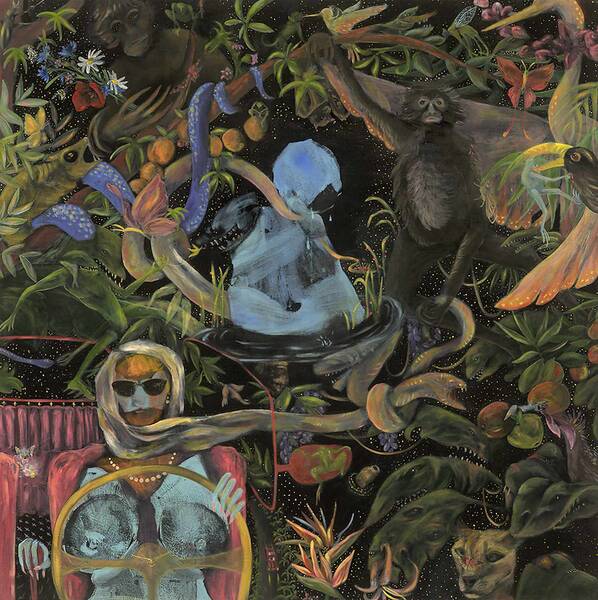
The Polish artist Emilia Jechna (1994) from Warsaw shows her engagement with mythology, spirituality and religion in her solo exhibition "What Narcissus Saw". Jechna works with classical Greek mythology and biblical stories like Adam and Eve and gives them a gift with her new works feminist reinterpretation.
Emilia Jechna is known for her figurative painting, in which she combines elements of surrealism, social criticism and mythology on her characteristic black background. Coupled with the exploration of mythological stories, the greatest source of inspiration for the artist is her own body, which itself is used as an artistic medium. This initial body cast results in Emilia's personal life flowing directly into the scenarios she envisions. Every environment she creates is born of pure intuition, the imprints of her body becoming the basis of every petal, tree branch and piece of fur she paints. Emilia rejects traditional notions of the female body and creates her works from a position of agency,
Jechnas' work is largely based on a mutual exchange between herself and the story she is portraying. Each painting is an expression of an inner dialogue in which the artist explores her own relationship to faith and spirituality. As someone steeped in religious thought from a young age, she hopes in her current exhibition to capitalize on recognizable myths.
In this series, Jechna does not focus on the rejection of her past - instead, she includes all aspects that have shaped her identity as an artist today: "It would be easy to reject all this now and see it as petty nonsense that I am exposed to I would rather think of it as a beautiful, interesting journey filled with doubt, magic and the need to find my own way of understanding life."